You have seven days to tell Canberra what is actually blocking AI in your organisation!
The new Joint Select Committee on Artificial Intelligence closes submissions on Monday 14th September. Here is what it is asking, why a one-page letter from a disability or aged care provider beats a glossy report, and a structure you can fill in this week.

Every few weeks a client tells me the same thing. "We would love to use AI for this, but we cannot work out whether we are allowed to."
Sometimes the "this" is drafting progress notes. Sometimes it is rostering, or incident summaries, or turning a two-hour intake conversation into a support plan. The tool exists. The staff want it. Then the organisation hits a wall: a funding agreement that says nothing about AI, a vendor contract that will not confirm where the data goes, a regulator whose guidance is still on the way, an insurer who has not thought about it, or a board that quite reasonably will not sign off on something nobody can explain.
For the first time, Parliament has asked to hear about exactly that wall. The new Joint Select Committee on Artificial Intelligence has put barriers to adoption in its terms of reference, and the window to say something closes in a week.
What has been set up, and why it matters
On 20 August 2026 both Houses passed resolutions establishing a Joint Select Committee on Artificial Intelligence. It was a Coalition initiative that the government backed, so it carries members from both sides of both chambers: twelve in all, with government, opposition and crossbench seats in each House. The motion in the House was moved by the Leader of the House, Tony Burke.
Two dates matter. Submissions close on 14 September 2026 and the committee must report by 30 November 2026.
That is a short inquiry. A short inquiry with a hard reporting date is one that reads its submissions closely, because it does not have time to commission much else. What lands on the committee's desk before 14 September is a large part of what shapes the report.
The terms of reference run from national security to copyright, and most of them will draw submissions from the big end of town. One paragraph is different. Paragraph (d) asks the committee to examine:
the rate and extent of AI adoption across the Australian economy, and the barriers to adoption, faced by small and medium businesses and family businesses
Read that as an open invitation. The committee has said, in writing, that it wants to know what is stopping smaller organisations from adopting AI. Nobody is better placed to answer than a provider that has tried, and stopped.
Paragraph (d) is the obvious home for a provider submission, but it is not the only one. The list also covers workforce and skills implications, the adequacy of existing laws and regulatory frameworks, how governments are adopting AI themselves, and risks such as fraud and deepfakes. If your barrier is that a funder or regulator has not told you what good looks like, that speaks to more than one paragraph, and it is fine to say so.
Why disability and aged care providers in particular
A lot of businesses will find paragraph (d) relevant. I want to make the case that disability and aged care providers should be near the front of the queue, for three reasons.
Your barriers are structural, not attitudinal. The usual story about small business and AI is that owners are unsure or short on time. Providers are different. Most of the organisations I work with are willing and, in places, ahead of their funders. What stops them is the data they hold, which is sensitive health and disability information about people who often cannot easily advocate for themselves; the funding and accreditation regimes they sit inside; and the absence of a clear path to a "yes" from anybody. That is a policy problem, which is precisely what a committee can do something about.
There is already a worked example of what "default no" does to a sector. The Department of Employment and Workplace Relations published its Third-Party AI Assessment Framework in September 2025. It's default position is that contracted providers must not use AI in service delivery without written approval for the specific use case. At Senate estimates on 3 June 2026, officials confirmed that eleven providers had applied and none had been approved. Providers licensed tools, trained staff, redesigned processes and then waited. That is the kind of concrete, dated, verifiable account a committee can quote. If you are living a version of it, say so. If DEWR's high barrier discouraged you from even trying, say so.
Nobody else will say it for you. Peak bodies will make submissions, and they will be good. They will also be general, because they have to represent everyone. A committee report gains its texture from the specific examples: the 180-staff provider in regional NSW that tried to use AI for progress notes and stopped because the vendor could not confirm Australian data residency. Those examples come from individual organisations, and they only exist if someone writes them down.
What makes a submission useful
I have read a lot of committee submissions over the years, and written a few. The pattern is consistent. The ones that get quoted are short, specific and honest about what happened. The ones that disappear are long, careful and say nothing that could not have been written by any organisation in the country.You do not need a lawyer. You do not need a policy team. You need one real story and a clear ask. The committee secretariat will read a single page with more care than a thirty-page document, because a single page tells them you respect their time.
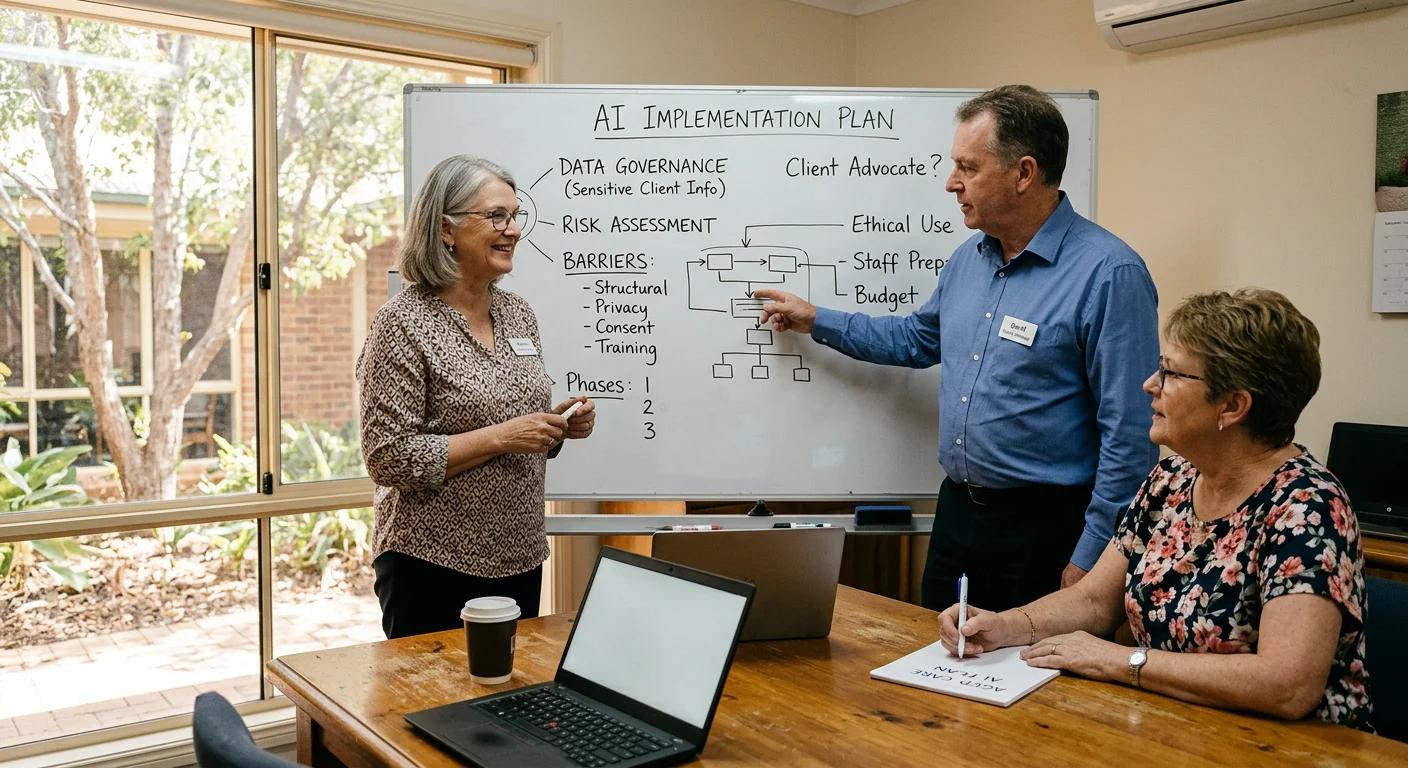
Providers are already doing the planning. The barriers they hit on the way are what the committee wants to hear about
Three practical points before you write.
1. Submissions are normally published on the committee's website, and they are protected by parliamentary privilege, which means you can describe what a department, funder or vendor did without fear of a defamation claim.
2. If part of your account is commercially sensitive, you can ask for that part to be kept confidential, but do not let that stop you from lodging. Do not include anything that could identify a participant, resident or client; the story is about your organisation's barrier, not about them.
3. Get the CEO or the board chair to put their name to it. A submission signed by the person accountable for the organisation carries more weight than one from the IT manager, and it is a governance decision in its own right.
A one-page structure for a disability or aged care provider
Here is the shape I would use. Six short parts. Aim for 400 to 500 words, headed with your organisation's name and the words "Submission to the Joint Select Committee on Artificial Intelligence, terms of reference paragraph (d)".
1. Who you are. Two or three lines. Sector, size, the funding you operate under (NDIS, Commonwealth Home Support Programme, residential aged care, state contracts), roughly how many people you support and where. This tells the committee whose voice this is.
2. What you tried to do. One use case, described plainly. "We trialled an AI tool to draft shift notes from support workers' voice recordings" is better than a paragraph about digital transformation. If you have a number, use it: hours per week, staff involved, what the tool cost.
3. What stopped you. The actual barrier, as specifically as you can. Common ones I see: the vendor would not confirm that data stays in Australia; the funding agreement is silent on AI and nobody would confirm whether use was permitted; the regulator has not said what it expects; the insurer could not price it; the board would not approve a tool that no one could explain; the only "approval" path available had no turnaround time. Pick the real one, not the impressive one.
4. What it cost you. Committees respond to consequences. Licence fees paid for a tool that could not be used. Staff hours lost to manual work that a permitted tool would have absorbed. And the quiet cost: staff using free consumer AI tools on their own phones because the approved path went nowhere, with sensitive information leaving the organisation as a result. If that is happening, say so. It is the single most persuasive fact you can give them, and it is happening everywhere.
5. What would have helped. One or two asks, stated as things the Commonwealth could actually do. A clear statement from funders on permitted AI use in service delivery. A single Commonwealth approval process instead of one per department. Standard contract terms for AI vendors serving the care sector, covering data location and retention. Guidance from regulators that says what good looks like rather than what is prohibited. Time-limited turnaround commitments where approval is required.
6. Whether you are willing to appear. One line. The committee will hold public hearings, and a provider who is prepared to say the above in person is valuable to them. If you would rather not, say that too.
That is the whole document. Sign it, date it, and lodge it through the committee's page before 14 September. Check the page for the current lodgement process before you write; the committee will state how it wants submissions received. Further official guidance on submissions